





What Really Happens at a Dueling Piano Bar in Downtown Houston
You ever walk past a place where the whole room is singing the same song at the top of their lungs, total strangers and all, and wonder how that even gets started? I used to think it was luck. A good crowd, a few drinks, somebody brave enough to break the ice.
Turns out it is way more deliberate than that. There is an actual craft to getting a room of people who have never met to act like old friends for a couple of hours.
I got curious about how dueling piano shows pull it off, so I called up Pete’s Dueling Piano Bar, a fixture for live music in Downtown Houston, and asked them to explain what really goes on once the room fills up. The short version surprised me. The long version is better.
It is not a concert, it is a conversation
Here is the thing I got wrong for years. I assumed the players had a setlist and you just sat there and listened, the way you would at a regular gig.
Nope.
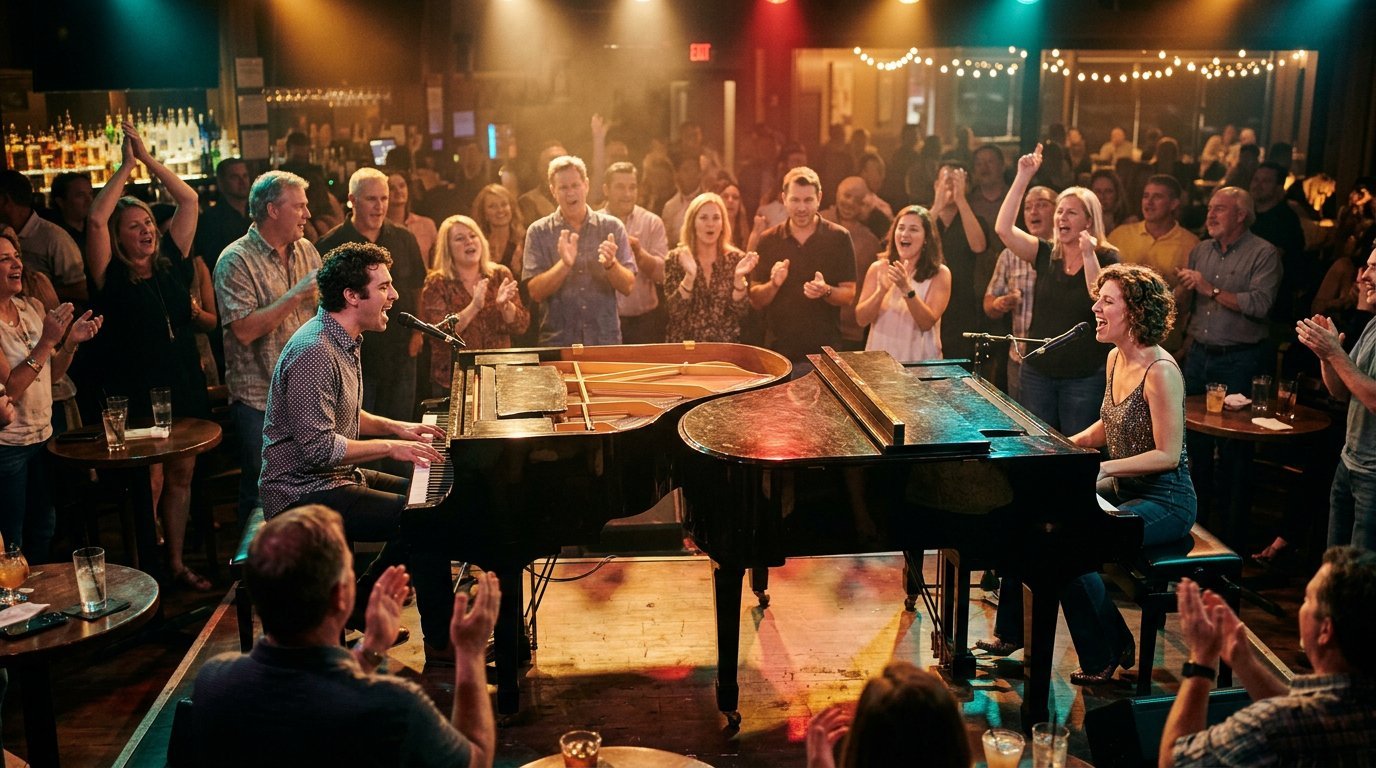
Two musicians sit at facing pianos and basically build the entire show out of what you ask for. The crowd writes the script as it goes, which means no two shows ever land the same way.
Nobody walks in with a fixed plan for the evening.
That changes the whole feel of the room. You are not an audience. You are kind of a co-writer.
Requests run the whole thing
The way it works is simple once somebody explains it. You jot down a song on a slip of paper, hand it up to the piano, and the players work it into the mix. Country, classic rock, the cheesy pop song you secretly love, the deep cut your friends will groan at. It is all fair game.
And because the requests are coming from every table, the music bounces around in a way a planned set never would. One minute it is a power ballad. Next it is something nobody has thought about in years that suddenly the entire bar remembers every word to.
That whiplash is the point. It keeps you leaning forward.
Tips are the steering wheel
This was the part I had no clue about. The tip you toss in with your request does more than say thanks.
It is your say in what plays next.
A bigger tip moves your song up the line. So if two tables want completely different things, the one that throws in a little more tends to win the next slot. It sounds cutthroat, but in practice it turns into its own running bit, with tables low-key competing and the players egging everyone on.
You do not have to tip to have a good time. But if you really want your song, a few bucks does more talking than waving your arms ever will.
The banter is half the job
Something I underrated is how much of the show is just talk. The music matters, sure, but the players spend a real chunk of the time reading the crowd and riffing off it.
They clock who is celebrating what. The table that keeps requesting the same artist. The group that clearly drove in from out of town. Then they fold all of it into the patter between songs, and the room starts to feel like it is in on a private joke.
It looks effortless. It is not.
Pulling that off means staying loose enough to improvise while keeping a hundred people moving in the same direction. The songs give them the structure. The crowd gives them the material. The work is stitching the two together so nobody notices the seams.
That is the part you cannot fake with a printed setlist.
Why the room actually bonds
So why does everybody end up singing together? I always figured that was the alcohol. Partly, sure.
But there is more to it.
When the music is built from requests, every song belongs to somebody in the room. That is somebody’s anniversary tune, somebody’s hype song, somebody’s inside joke with their best friend. You are not hearing a stranger’s playlist. You are hearing the whole room’s playlist, one slip of paper at a time.
The players lean into that hard. They read the crowd, they crack jokes, they call out the bachelorette party in the corner and the buddies who clearly lost a bet. It is loose and a little chaotic and that is exactly why people loosen up.
By the time a song everybody knows comes around, you are already part of it.
No two crowds ask for the same thing
Here is something that stuck with me. The setlist ends up being a kind of fingerprint of whoever walked in.
One room leans hard into classic rock the whole time. Another cannot get enough of the cheesy pop singalongs. A third stays all over the map because every table wants something different and nobody backs down.
The players just roll with it. They are not nudging you toward their own favorites, they are handing yours back to you, a little louder and a lot more fun than your car stereo ever managed.
So the show you get is sort of yours.
You and a few dozen strangers built it together without ever meaning to, and you will never see that exact version of it again.
It works for almost any group
What struck me talking to the folks at Pete’s is how many different reasons people show up. Birthdays. Date plans. A work crew that needs to blow off steam after a long stretch. Big group reunions where half the people have not seen each other in ages.
The format kind of absorbs all of it. A couple on a quiet date can hang at the rail and just watch. A loud group of twelve can take over a section and become the heart of the show. The room flexes around whoever is in it.
That is harder to pull off than it looks. Most venues are built for one vibe. This one shifts depending on who walks in.
You do not need a plan
Here is what I appreciated most. You can overthink a night out, or you can just show up.
Walk-ins are welcome, and even when the tables fill up there is standing room and rail seating, so you are rarely stuck outside looking in. No deep strategy required. You bring a couple of friends and a song you want to hear, and the room handles the rest.
That low barrier is underrated. So much of going out these days feels like it needs a reservation, a theme, and a group chat with forty unread messages.
This is closer to the opposite of that.
It is the opposite of a quiet bar
I asked how this compares to just grabbing drinks somewhere, because honestly that was my default for years. A booth, a playlist nobody chose, a conversation you have to lean in to hear.
This is the other end of the spectrum.
The whole room is pointed at the same thing, so the energy stacks instead of scattering. You are not fighting the background noise. You are the background noise, and so is everybody else, and somehow that is the fun of it. People who came in shy end up belting choruses they would never admit to liking.
I think that is why groups keep coming back. It does the social work for you.
What I would tell a first-timer
If you have never done one of these, a few small things make it better.
Bring cash for requests, even though cards work fine for everything else, because handing a slip up with a tip is half the fun. Show up with at least one song in your back pocket so you are not scrambling when the moment hits. And do not be the table that just sits there. The show feeds on energy, and the more you put in, the more the players hand back.
Honestly though, the best move is to not script it too much.
The whole appeal of a request-driven show is that it goes somewhere you did not expect. You came in wanting one song and you leave having screamed along to ten you forgot you loved.
That is the trick the room pulls on you. You think you are there to watch a couple of piano players, and you end up being part of the act.
So next time you are trying to figure out where a random group of people can turn into one loud, happy mess for a few hours, you know where the magic actually comes from.
It is not luck. It is a stack of paper slips, two pianos, and a room willing to play along.