






How to Pick a Dentist in New Brighton Without Wasting an Appointment
Most people pick a dentist on Google reviews and a five-minute drive. That works often enough that it never gets questioned. Until you book the first appointment and something feels off, and now you’ve used a vacation half-day on a practice you’re not going back to.
The signals that actually predict whether you’ll like a dentist are almost all visible before the cleaning chair. They’re just not in the marketing.
Parkside Dental, a trusted dentist in New Brighton, walked me through what they see on a patient’s first visit, including the questions people ask the most and the ones almost nobody thinks to ask before booking.
What came out of that conversation is below. Some of it is uncomfortable. Most of it is stuff you’d want to know before you spend an hour in someone’s chair.
Reviews are a signal, not a verdict
Star ratings catch a few real things. Whether the front desk is friendly. Whether appointments start on time. Whether billing surprises are common. They miss a lot.
They almost never tell you whether the dentist is conservative or aggressive with treatment. Two dentists looking at the same X-ray will give wildly different recommendations, and the gap can be thousands of dollars. A practice with 4.9 stars and a watch-and-wait philosophy is going to feel very different from a practice with 4.9 stars and a fix-it-now philosophy, and the reviews will look almost identical.
What’s actually worth reading is the one-star and two-star reviews, especially the recent ones. People who got upsold tell you. People who got billed for things they didn’t expect tell you. People who felt rushed tell you. The five-star reviews mostly just mean the front desk is good at their job.
What a good practice does with negative reviews
Look at how the practice responds to bad reviews. A practice that engages thoughtfully, owns mistakes, and doesn’t get defensive is usually a practice run by someone who handles patient conversations the same way in person. A practice that argues with a one-star reviewer is going to argue with you about your bill.
The insurance conversation is the first real test
Call before you book. Ask the receptionist a few specific questions. What does the new patient exam cost without insurance applied? What’s a typical out-of-pocket for a basic filling? Do they pre-verify benefits before your appointment?
A good practice has answers ready or will get them and call you back. A practice that gets vague or says they’ll figure it out at the desk when you come in is telling you what billing day is going to look like. You don’t want to be standing at the front desk with a card out, hearing about a charge you didn’t expect, while the next patient waits behind you.
The pre-verification question matters more than people realize
Some practices verify your insurance benefits before the appointment. Others run your card and bill you for the difference after the claim processes. The first kind almost never produces surprise bills. The second kind almost always does.
If the receptionist doesn’t know what pre-verification is, that’s information too.
The first ninety seconds of the exam tell you most of what you need
How the dentist walks in matters. Did they read the chart? Did they look at the medical history? Do they remember your name without checking the file?
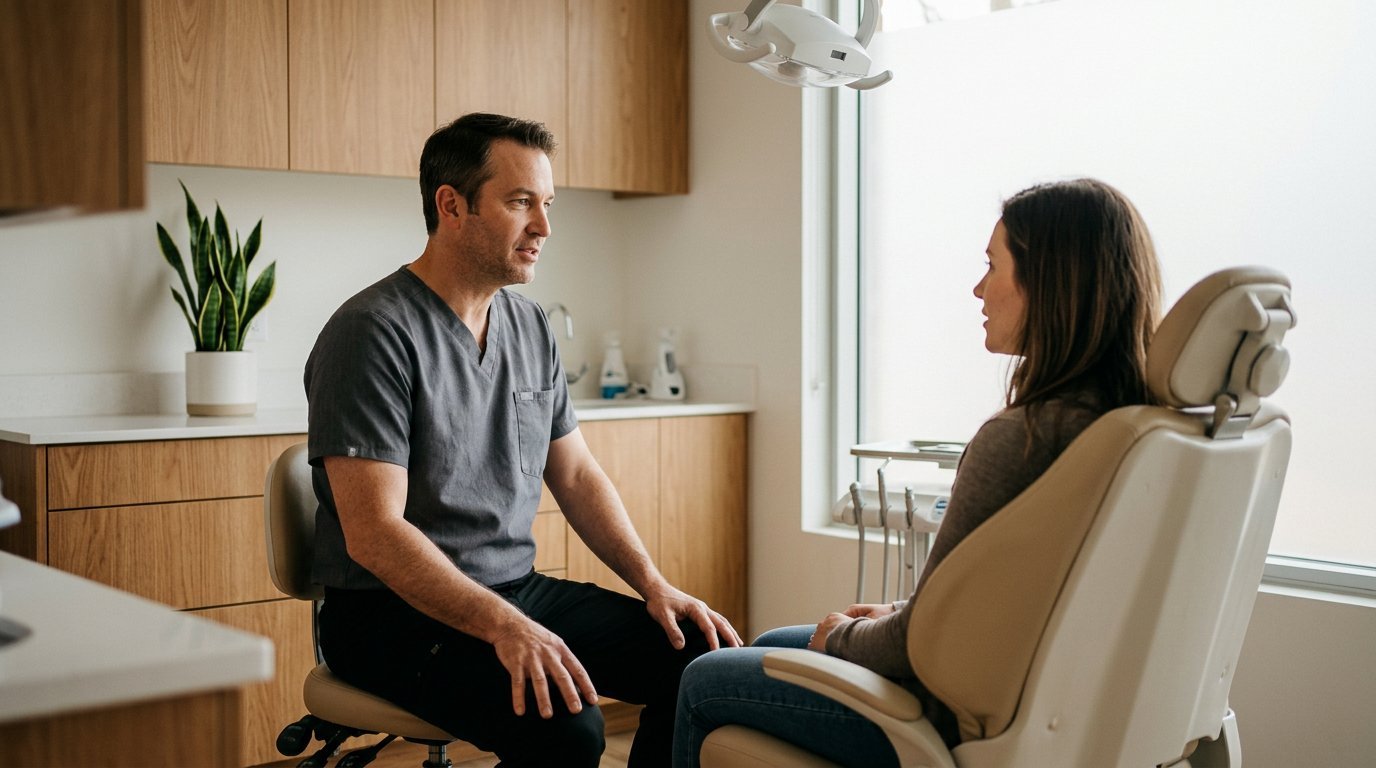
A dentist who introduces themselves, sits down, and asks why you’re there before reaching for the explorer is a dentist who treats you as a person. A dentist who walks in already snapping on gloves and asking the hygienist what the chart says is in a hurry, and they’re going to keep being in a hurry.
You can also watch what they do during the exam. Are they talking to you, or talking past you to the hygienist? Are they explaining what they’re seeing, or just muttering codes the assistant writes down? You will feel both kinds of visits in the first two minutes, and you should pay attention to which one you got.
The “if this were your tooth” question
Before you leave the chair, ask any dentist some version of this question. If this were your tooth, what would you do? Watch how they answer. A direct, specific answer is a good sign. A long discussion of options weighted toward the most expensive one is a less good sign.
Most New Brighton families switch dentists because of a treatment plan they didn’t trust, not because of the cleaning quality. This question surfaces the treatment philosophy before you’ve committed to anything.
Where new patients usually trip themselves up
A few patterns show up over and over.
People often book the cleaning at the same visit as the meet-and-greet. There’s nothing wrong with this in principle, but if the dentist is rushed, the cleaning will be rushed, and you’ll feel it. Booking the exam first and the cleaning separately is a small inefficiency that produces a much better first visit.
Skimming the medical history form is another common move. The form is tedious. It also flags drug interactions that matter for anesthetic, lets the dentist understand your bleeding tolerance, and prevents bad guesses if something goes sideways. Fill it out honestly and completely, even the embarrassing parts.
The most expensive habit is saying yes to anything mid-cleaning. The hygienist will sometimes mention that you should think about something. A scaling upgrade, a fluoride add-on, a whitening treatment. The right answer in the chair is almost always that you want to discuss it with the dentist before deciding. Cleaning chairs are a bad place to evaluate financial decisions.
Why mid-appointment upsells are unreliable
You’re reclined. There’s a suction tube in your mouth. The hygienist is being kind and professional. You feel rude saying no. None of that is a good basis for agreeing to a $90 add-on. Step out, get pricing in writing, think about it.
A practice that gets aggressive about mid-cleaning yes-or-no decisions is a practice you should be careful about. A practice that says totally, let us know later, is one you can trust.
Distance matters less than people think
New Brighton is small enough that most practices are within a ten-minute drive. The actual friction in dental care isn’t the commute. It’s scheduling. After-hours availability for unexpected problems, emergency policies for the bad ones, and how easy it is to reschedule when life gets in the way.
Ask about emergency coverage before you commit. Some practices have an on-call rotation. Some hand you off to an emergency clinic across town. Neither is automatically wrong, but you want to know which yours is before you need to know.
What a missed appointment actually costs
Some practices charge a no-show fee, usually $50 to $75. Some won’t reschedule cancellations within twenty-four hours for several weeks. Some are quietly flexible if you call ahead. The policy itself isn’t the issue. Knowing the policy is.
This is one of those questions a receptionist either answers immediately or fumbles. The answer itself doesn’t matter as much as how it gets delivered.
The signals that are mostly noise
People weigh some things heavily that probably shouldn’t carry much weight.
Office decor. A nice waiting room is pleasant. It doesn’t predict clinical care.
Practice size. Solo practices and group practices both work. Both can be excellent. Both can be mediocre. Size correlates with almost nothing useful.
Newest technology. Digital X-rays and intraoral cameras are nice to have. They don’t turn a poor dentist into a good one, and a great dentist can do excellent work without the latest equipment. Buy the dentist, not the room.
The thing that does predict experience reliability is attention. How present does the dentist seem when they’re working on you. That signal is harder to evaluate from a website, but it’s the one that matters.
What to bring on the first visit
A few practical things make the first appointment go better.
Bring your last X-rays if you can get them. Call your previous office and ask them to send the files over a few days ahead. Most offices will do this without complaint. New X-rays cost money and add radiation exposure, even though it’s low, and a recent prior set saves both.
Bring a list of medications you actually take, including supplements and anything occasional. The are-you-on-anything question gets answered badly by everyone, and a written list saves the dentist from guessing.
Bring a list of dental concerns in your own words. “I want a checkup” is not a useful list. “The lower right molar aches when I drink cold water, my old front filling looks gray, and I’ve been grinding my teeth in my sleep” is a useful list. Write it down before you go. You will forget half of it in the chair.
The wrap-up conversation worth having
Before you leave, after the exam, while you’re still in the chair, ask two open-ended questions.
What’s the one thing you noticed today that you want me to be aware of, even if it’s not a treatment recommendation yet?
If this were your tooth, what would you do?
Both questions surface information that doesn’t show up on the treatment plan paperwork. A dentist who has a clear, specific answer is a dentist who’s paying attention. A dentist who gives you a generic talking-points answer is a dentist who’s running a workflow.
You will know within thirty seconds which kind you have.
The shortcut
If you only remember one thing, it’s this. Pick a practice that talks to you like an adult, prices the basics up front, respects your no when you give it, and answers the if-this-were-your-tooth question without flinching.
That’s most of what matters. The rest is logistics.
The first visit to a new dentist is a calibration appointment more than a clinical one. You’re learning the practice’s philosophy, the front desk’s competence, and the dentist’s attention to you specifically. If any one of those feels wrong on the first visit, it isn’t going to get better on the second.
Pick carefully and you won’t be picking again for a long time.