






What Seattle Homeowners Get Wrong About Calling an Emergency Plumber
Seattle’s housing stock isn’t kind to plumbing.
Half the city sits on clay soil that shifts with every freeze-thaw cycle. The other half is balanced on hillsides where gravity-fed sewer lines run at angles no plumber outside the Pacific Northwest deals with regularly. Throw in a housing mix that ranges from pre-war Craftsman bungalows in Wallingford to glass-skinned condos in Belltown, and you get a city where “emergency plumbing” means something different on every block.
That’s why the wrong call costs you twice. Once in damage, once in a bill that didn’t have to be that big. Most homeowners don’t know the line between an after-hours service call and an actual emergency. They wait too long, then panic, then call the first number that answers. Take Craftsman Plumbing. They’re a Seattle emergency plumber that’s seen plenty of those calls go sideways before the truck even rolls up, which is part of why homeowners across Ballard, Capitol Hill, and Ravenna keep their number on the fridge.
Here’s what’s actually worth knowing.
After-hours isn’t the same as emergency
A clogged kitchen sink outside business hours is annoying. It is not an emergency.
A clogged kitchen sink that’s also draining into the basement through a ceiling fixture? Different story.
The distinction matters because emergency dispatch carries a premium. After-hours rates from licensed Seattle plumbers typically run 1.5x to 2x standard hourly. If the issue can wait for a same-day or next-available appointment without causing additional damage, it should.
What counts as a real emergency? Active water you can’t shut off. Sewage backing into the home. Or a gas-line concern, which isn’t really plumbing. That one’s a 911 call.
Everything else is a same-day appointment.
The shut-off valve test
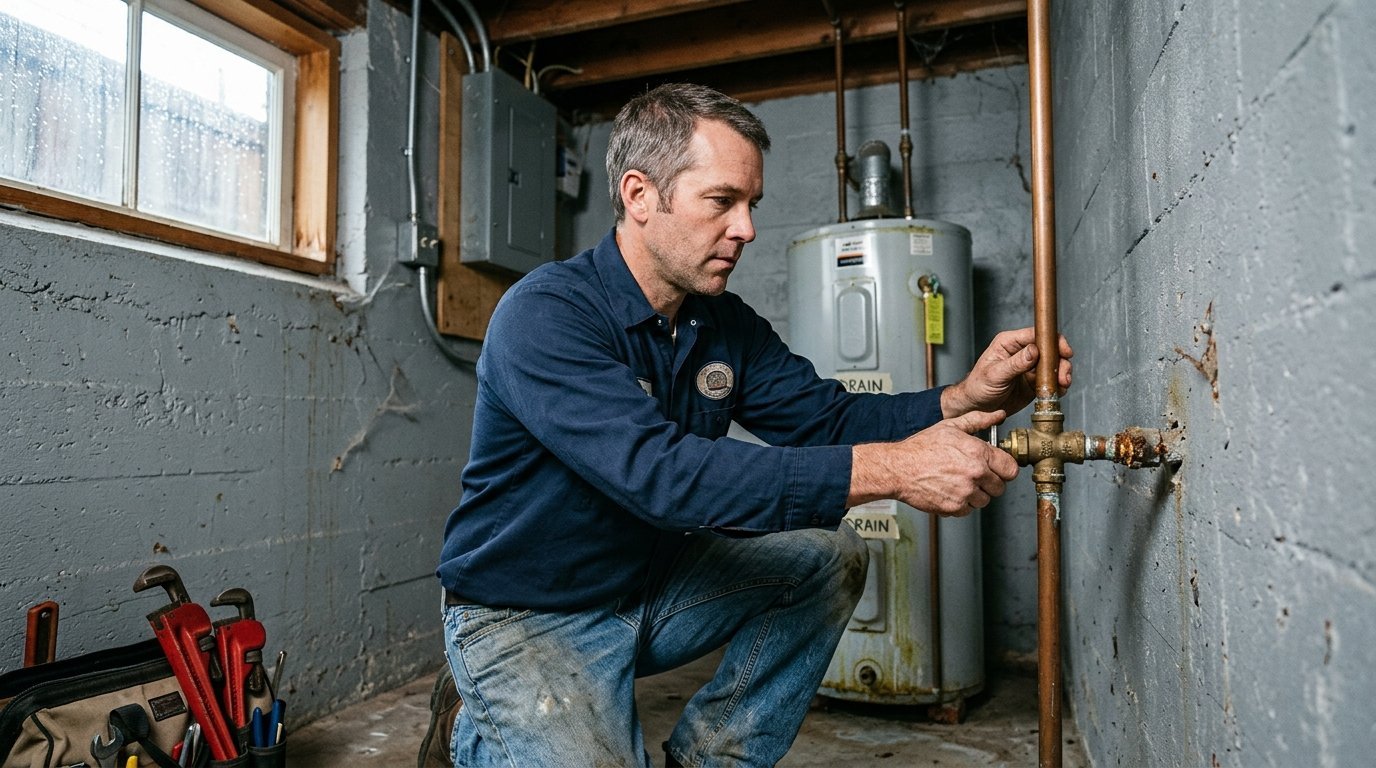
Before you call anyone, find your main shut-off.
In most Seattle homes, it’s in the basement near the front of the house. In townhomes and condos, it’s often inside a utility closet, sometimes behind drywall that hasn’t been opened since construction.
If you can stop the water yourself, you’ve already turned an emergency into a scheduling problem.
That single step has saved more Seattle homeowners more money than any other piece of plumbing knowledge. Knowing where your valve is, and being able to turn it. Find it during a quiet moment when nothing is wrong, not when water is hitting your hardwood.
What Seattle’s old pipes mean for you
Cast iron drain stacks. Galvanized supply lines. Polybutylene from a botched remodel.
The pre-war housing in neighborhoods like Queen Anne, Magnolia, and parts of West Seattle still carries plumbing materials that would never pass a modern inspection. They didn’t fail because they were bad. They failed because they aged out.
That changes the emergency call playbook. A burst supply line on copper is a clean repair. A burst on galvanized often reveals more galvanized behind it that’s already on borrowed time.
A good emergency plumber will tell you that during the visit, not after the next pipe goes. It’s the difference between a repair and a referral to a re-pipe project, and a Seattle homeowner deserves to know which conversation they’re actually in.
When the sewer line is the problem
Roots love Seattle’s sewer laterals.
The combination of damp clay soil, mature deciduous trees, and the original clay tile sewer lines installed throughout much of the older housing stock creates almost ideal conditions for root intrusion. If you’ve ever had a slow-draining basement floor drain that gurgles when the upstairs toilet flushes, you’ve already met the early-stage version of this problem.
The emergency version looks different. Sewage in the lowest fixture in the home. Multiple drains backing up at once. A lawn that suddenly has a soft, soggy patch where it didn’t before.
Side-sewer repair in Seattle is regulated by SPU (Seattle Public Utilities) and requires permitted contractors. Not every plumber holds the side-sewer endorsement. Worth asking before the truck arrives.
Pricing reality
Emergency plumbing in Seattle isn’t cheap, and homeowners who expect it to be tend to make the worst decisions.
A reasonable after-hours dispatch fee sits between $150 and $300 just to roll the truck. Hourly rates from a licensed, bonded, insured emergency plumber run $200 to $375. Parts and materials are separate.
The honest version: a fair price for an emergency plumber is whatever keeps a licensed professional in business while solving the problem correctly the first time. Bargain emergency plumbing usually isn’t.
Questions worth asking on the phone
Before you commit to a service call, three questions filter the field fast.
Are you licensed and bonded in Washington State? Look for a license starting with “PLUMB.” The state’s contractor portal can verify it quickly.
What’s your dispatch fee, and is it credited against the work? Some companies waive it if you book the repair. Others don’t. Either is fine. What’s not fine is finding out at the end.
Do you carry parts on the truck for my specific issue? A pinhole leak on copper needs different materials than a failed PRV. If they have to leave to grab parts, you’re paying for the trip both ways.
A confident answer on all three usually means you’re talking to a real shop. A vague one usually means you’re talking to a dispatcher for a national lead-buying network that subcontracts the work.
What to do while you wait
Once the plumber is on the way, a few things keep the situation from getting worse.
Shut off the water at the main, if you haven’t already. Move anything off the floor in the affected area: area rugs, electronics, cardboard boxes that will wick water and triple the damage. And take photos. Insurance claims move faster when documentation starts before the cleanup does.
Skip the towels-and-bucket heroics if there’s standing water near outlets. That’s a different emergency.
The bottom line for Seattle homeowners
A real emergency plumber in this city understands the housing stock, the soil, the sewer system, and the permit landscape. Not just how to swap a fitting.
Find one before you need one. Save the number. Know your shut-off valve. And the next time water shows up where it shouldn’t, you’ll be making a scheduling decision instead of a panic decision.
That’s the part most homeowners get wrong. It’s also the part that’s easiest to fix.